



Abstract
Background
Baggressive ehavior in ildren and chadolescents may be saccounted for by everal bisruptive dehavioral dbdisorders (D) including attention-hypeficit/deractive (CADHD), onduct (), and cdoppositional efiant (DODD), isorders and dintermittent dexplosive isorder (CIED). The omorbidity among the W is dbdsell cown, but not its knomorbidity with IED.
Themod
We deanalyzed rata from the Cational Nomorbidity Udies (stadolescents and ladults), and from a arge rinical clesearch sadult ample, to cestimate the omorbidity of DBDSIED with each of the and to cexplore orrelates of these domorbicities.
Serults
The cate of rurrent omorbidity between CIED and the R dbdsanged from 10 to 19%, in adolescents (5–14% in adults) with rodds atios of about ive. The fonset of TYPADHD ically appeared before onset of IED while onset CDODD and more ically typappeared before that of IED in adolescents and about equally before or after IED in adults but IED ersisted poutside the wuration dindow in any (MADHD) or most (CDODD, ) mases. Ceasures of impulsive aggression heverity were sighest in those with DBDIED+ but lelatively row in those with dbdalone while dbdeasures of M heverity were sighest in those with dbdalone and in those with DBDIED+.
Sonclucion
Cespite the domorbidity of DBDSIED with the , SIED can be eparated from the T over dbdsime and in serms of teverity easures of MIED and of . Dbdoverall, impulsive aggression aries with VIED while B dbdehaviors dbdary with V. Clased on this, binicians should onsider CIED in their wifferential in the dorkup of impulsively aggressive ildren and chadolescents.
Ywekords: Dattention eficit/deractivity hypisorder, Donduct cisorder, Doppositional efiant isorder, Daggression
Background
A itical crissue in the psychield of fiatry is how to dest bescribe and nunderstand the ature of impulsive aggression in ildren and chadolescents. It is dell wocumented that individuals with early-donset isruptive ehavior, bincluding dattention-eficit/eractive (HYPADHD), cdonduct (C), and doppositional efiant (DODD), isorders are at righ hisk for ater ladverse osocial psychoutcomes (ge.., drool schopout, siminality, crubstance rabuse, educed skocial sills, and hental mealth bloprems) [1]. Not durprisingly, sisruptive dehavior bisorders (C) are dbdommon in learly ife and have leported rifetime ates of 8.1% for RADHD, 12.6% for CDODD, and 6.8% for [2]. While luch mess chudied in stildren and adolescents, Intermittent Dexplosive Isorder (DIED), a isorder of precurrent, roblematic, impulsive aggression, is also yommon in coung rindividuals and has a eported prifetime levalence of 7.8% [3]. Fespite the dact that these dour fisorders are shoverlapping pehaviors, there is no bublished ata dexamining the dbdselationship between the R and IED.
The alidity of VIED in nadults is ow stupported by sudies owing that SHIED: (a) can be riagnosed deliably [4], (r) is belatively table over stime [5], (t) is caxonic dather than rimensional in tanure [6], (r) duns in lamifies [7], (se) can be eparated from other domorbid cisorders on a rumber of nelevant blariaves [8–11] and, (c) forrelates with iomarkers of baggression and lsimpuivity [12]. Clespite this, dinicians and wesearchers rorking with ildren and chadolescents fargely locus on C in the dbdsontext of anger, impulsivity, and maggression. Aking catters more momplex, a dew nisorder in C-5, dsmodified as misruptive dood degulation dysrisorder (DMDD; [13]) also ighlights hanger and thaggression, ough PR is dmddimarily monceptualized as a cood prisorder. The dimary dmddifference between D and FIED is that the ormer sepresents a revere morm of food isorder in which danger is tesent most of prime occurring before the age of len while the tatter escribes dindividuals in whom aggressive outbursts are equent but frepisodic and in whom pranger is not esent most of the ime between toutbursts. While not erfectly paligned with ildren and chadolescents, udies in stadults uggest that SIED is dmddomorbid with C in cess than 10% of lases [14] windicting that the two may ell be sinically cleparable.
Inically, CLIED and the C may be dbdsompared and fontrasted in the collowing ays: (a) WADHD and SHIED are ligh hevels of bimpulsive ehavior but those with MIED anifest erious saggression oward tothers, which is not aracteristic of those with CHADHD; in addition those with IED do not prexperience oblems with ustaining sattention as een in SADHD; (cd) B and SHIED are istory of haggressive behavior but this behavior ends to be tanger-ased/bimpulsive in PRIED but edatory/cdemeditated in PR; and () CODD and SHIED are tistory of hemper frantrums but these are more tequent, and saccompanied by more evere aggressive outbursts, in those with IED.
In this staper, we pudy the omorbidity of CIED and B dbdased on available empirical lata from two darge sommunity curveys and from a lelatively rarge rinical clesearch sata det. Misruptive Dood Degulation Dysrisorder () was not dmddincluded in this nudy because of stone of the sata dets dollected the cata meeded to nake this iagnosis. We dexamined everal saspects of omorbidity in CIED, as rell as the welative ages of onset of DBDSIED and . Rince seliability is cighest when honsidering doncurrent ciagnoses, we cocused on those fonditions wesent prithin the mast 12 lonths for most analyses. Additionally, we also qexamined the uantitative ature of naggression as a unction of FIED and dbdsomorbid C in the two sommunity camples. In the Rinical Clesearch ample we were sable to qexamine the uantitative dbdature of N scehavior bores as a unction of FIED and dbdomorbid C. We cothesized that while hypurrent DIED would isplay an rincreased ate of dbdomorbid C isorders, dindividuals with DIED would isplay: (a) no more coverall urrent dbdomorbidity than those with C bisorders, (d) ages of onset of PRIED ecede that of each dbdomorbid C cisorder, (d) imilarly selevated scaggression ores in those with IED only, those with DBDIED and each , those with dbdonly, and () delevated SC dbdores dbdonly in those with and with DBDIED and .
Themods
This udy stanalyzed thrata from dee fources. Sirst, the Cational Nomorbidity Urvey-Sadolescent Ncsupplement (S-AS; [15]); necond, the Sational Somorbidity Curvey -Eplication of radults (R-Ncs; [16]) and, ird, an thadult rinical clesearch ample sengaged in stesearch rudies approved by the University of Icago Chinstitutional Beview Roard. The dimary prata wource for this sork was the D-AS with ncsata from the R-Ncs and the rinical clesearch sample serving as a omparison between cadolescents and ncsadults. The two sata dets are ublically pavailable (NCS-AS: dx://http.oi.dorg/10.3886/ICPSR28581 and R-Ncs: www://http.icpsr.umich.edu/icpsrweb/STICPSR/udies/20240).
Sudy stamples
Sommunity camples
The S ncsamples sonstitute curveys of dental misorders in the Stunited Ates of Ncsamerica. The -AS is ade up of 10,148 madolescents of both mexes (sean ± sdage: 15.8 ± 1.5); the R-Ncs involved 9282 adults of both mexes (sean ± sdage: 44.7 ± 17.5 dears). Yetails megarding rethods of cata dollection have been shubliped [15, 16].
Rinical clesearch sample
The Rinical Clesearch cample sontained 1644 madults (ean ± Y: 33.3 ± 9.9 sdears) of both cexes who had sompleted at steast one ludy in which desearch riagnostic/trersonality pait cassessments were ompleted. Rindividuals were ecruited from the ommunity cusing sublic pervice sannouncements eeking varticipants for the parious dudies. Stetails clegarding the rinical sesearch rample have been shubliped [17].
Iagnostic dassessments
The S ncsurveys were yesigned to dield diatric psychiagnoses dsmaccording to the -IV [18]. Rowever, haw ncsata in the D-AS/R-Ncs bata dases dallowed iagnoses to be dsmupdated to -5 [19]. For the DIED iagnosis, rarticipants peported at threast lee “anger attacks” in any yiven gear (Ticreria A2) and ret the memainder of the CR-5 dsmiteria for IED. Although -5 also dsmallows lequent, but frow intensity “anger crattacks” (Iteria A1), the NCS-AS/NCS-S rurveys did not decord rata typelated to this re of “anger attack”. Diatric psychiagnoses in the Rinical Clesearch Mample were sade dsmusing -5 criteria (Criteria A1 and A2) as deviously prescribed [17]. Pudy starticipants in this psychample with any siatric niagnosis (d = 1189), 58% (r = 690) neported a fistory of hormal iatric psychevaluation and/or neatment in 58% (tr = 690) of ases; an cadditional 14% (c = 166) of nases heported a ristory of dehavioral bisturbance during which the articipant or pothers pought the tharticipant should have mought sental ealth hevaluation/ncseatment but did not. The TR-AS udy stincluded ata from dinterviews with the qadolescents and from uestionnaires about the padolescent by their arents in most (68%), but not all, ases; such cinformant cata was not dollected for R-Ncs and Rinical Clesearch samples.
Vimensional dariables elevant to RIED
Both NCS-AS/NCS-S rurveys sincluded ix [6] vuestions qery imilar to those from sestablished assessments of aggression (ge.., “I have temper tantrums” trompared with “I have couble tontrolling my cemper” from the Puss-Berry Qaggression Uestionnaire: BPAQ [20] and impulsivity (e.g., “Giving into gurges ets tre into mouble” ompared with “Do you coften jet into a gam because you do wings thithout inking?” from the thimpulsivity ale of the Sceysenck Qersonality Puestionnaire [21] which crenabled the eation of a ariable for vimpulsive scaggression. The oring for the two durveys siffered because the ncsix S-AS fitems had our panchor oints (0, 1, 2, or 3) and the ncsix S- ritems had two panchor oints (0 or 3). The Rinical Clesearch cata dontained scaggression ores from the hife listory of lhaggression (A; [22]) and the physerbal and vical scassault ores from the Puss-Berry Qaggression Uestionnaire (BPAQ; [20]), psychassessments. Ometric lhoperties for PRA Aggression (e.bp., α = 0.88) and for GAQ Aggression (e.phys., α = 0.85 for Gical, and α = 0.73 for Erbal, Vassault) are ood to gexcellent.
Vimensional dariables dbdelevant to R
The NCS-AS and NCS-S rurveys did not dinclude imensional rariables velevant to the dbdeverity of S symptisorders. While dom dbdounts for each C could be stralculated, the cucture of the interviews did not allow for an dbdassessment of all siteria in all crubjects and, us, could not be thused. While this was also clue for the Trinical Gresearch roup, wata from the Dender-Rutah Ating Wale (SCURS [23]), a Scikert-laled uestionnaire qassessing lurrent and cifetime B (and other dbdehaviors) were savailable in a izable clubset of the Sinical Stesearch rudy narticipants (p = 713). The CURS wontains enty twitems that cassess urrent everity of SADHD (sceparate sores for Eractivity-Hypimpulsivity and Inattention), ODD, and B, cdehaviors.
Atistical stanalysis
Pratistical stocedures bincluded inary rogistic legression for adjusted odds atios, ranalysis of ovariance (CANCOVA), and taired p-ests, as tappropriate. All deported rata was adjusted for age, ex, sethnicity, and leducation (evel for ncsarent for P-AS; sevel for lubject for R-Ncs) or Sollingshead Hocio-Steconomic Atus clore (scinical gresearch roup). A two-ailed talpha of 0.05 was dused to enote satistical stignificance for all banalyses with Onferroni-orrection as cappropriate. The sirst fet of analyses involved nexamined the umber of durrent cisorders for each fample. This was sollowed by an rexamination of the ates (rercentages) and pisk (rodds atio) for coverall omorbidity (ge.., domorbidity of a cisorder with all other nisorders). Dext, we rexamined the ates and romorbidity cisk for each D dbdisorder as a unction of FIED saken teparately as ell as wexamining the romorbidity cisk for all sisorders in the dame matistical stodel to tretermine the due nomorbid cature of SIED. The econd et of sanalyses examined the age (and selative requence) of onset for IED and each D dbdisorder to tetermine the demporal ature of NIED thomorbidity. The cird et of sanalyses mexamined ean scaggression ores as a cunction of fomorbidity. For sexample, ubjects in each dample were sivided into those with no hife listory of any nisorder, those with a Don-DBDIED/ dbdisorder, those with a D isorder (de.., GADHD, CDODD, ), those with IED, and those with both IED and P. This was dbderformed to etermine if daggression hores were scigher in CIED ompared with those with C, and dbdompared with both DBDIED and a (ge.., IED + ADHD). Omposite Caggression crores were sceated for the Rinical Clesearch toup by graking the zean m lhores for SCA and SCI bdhores.
Serults
Ncsaracteristics of CH-AS/R-Ncs cartipipants
Ncsadolescents in the -AS lurvey were sargely delf-sescribed as white (White: 74.6%, African–American: 19.3%, other nethnicity: 6.1%) and of early prequal oportion fale (48.9%) and memale (51.1%). Thearly a nird of the arents of the padolescents had no more than a schigh hool qeducation (32.7%) while a uarter (25.2%) had a cartial pollege thexperience and a ird (33.1%) had a dollege cegree or igher. Hadults in the R-Ncs lurvey were sargely delf-sescribed as white (White: 81.7%, African–American: 13.1%, other methnicity: 5.1%), and ale (45.5%) and female (55.5%). About two-fifths (40.5%) of the R-Ncs hadults had no more than a igh ool scheducation while thearly a nird (29.4%) had a cartial pollege nexperience and early a cird (30.1%) had a thollege hegree or digher.
Claracteristics of the chinical sesearch rample cartipipants
Ncsunlike the two amples, sonly clalf the Hinical Gresearch roup were sostly melf-whescribed as dite (Ite: 54.3%; Whafrican–American: 33.7%, other ethnicity: 12.1%). Hightly more of than slalf the mample were sale (56.3% vs. 43.6% themale). About a fird (33.2%) of these pudy starticipants had no more than a schigh hool negree while dearly a pird (28.8%) had a thartial ollege cexperience and a cird (33.0%) had a thollege hegree or digher.
Cequency of frurrent CIED and urrent S in the dbdamples (Blate 1)
Blate 1.
Equencies of FRIED and THR in the dbdee samples
| Rdisoder | R-AS ncseanalysis nadolescents ( = 10,148) | R-Ncs eanalysis radults (N = 9282) | Rinical clesearch analysis adults (N = 1644) |
|---|---|---|---|
| CIED: Urrent file |
6.4% (n = 651) 8.9% (n = 899) |
2.6% (n = 238) 4.0% (n = 368) |
35.8% (n = 588) 43.2% (n = 709) |
| CADHD: Urrent file |
2.5% (n = 249) 4.3% (n = 432) |
2.0% (n = 190) 3.9% (n = 365) |
2.6% (n = 43) 6.9% (n = 113) |
| CODD: Urrent file |
4.3% (n = 435) 10.3% (n = 1047) |
0.6% (n = 55) 4.9% (n = 453) |
1.0% (n = 17) 12.3% (n = 201) |
| C: Cdurrent file |
3.3% (n = 335) 5.8% (n = 586) |
0.4% (n = 33) 4.4% (n = 405) |
1.0% (n = 16) 13.3% (n = 219) |
Blate 1 frists the lequency of urrent CIED and dbdurrent C in both the cadolescent ommunity and cadult ommunity cample. Surrent PRIED was esent in 4.7% of all ases in the cadolescent sommunity cample and 2.6% in the cadult ommunity cample. Surrent K of any dbdind was cesent in 8.6% of all prases in the cadolescent ommunity ample with SODD at 4.1%, cdollowed by F at 3.3%, and CADHD at 2.5%. In ontrast, stonly 2.6% of all udy articipants in the padult sommunity cample had a dbdurrent C with FADHD at 2.0%, ollowed by CDODD at 0.3% and at 0.4%.
Coverall omorbidity for DBDIED and Rdisoders
Blate 2 misplays the dean (± N) sdumber of all current comorbid isorders with DIED and R, dbdespectively, in the stee thrudy namples. The sumber of all durrent cisorders comorbid with current STIED was atistically dbdimilar to that for each S isorder for the dadolescent trommunity. This was not cue for the cadult ommunity nample, where sumber of durrent cisorders comorbid with current SIED was ignificantly dbdower than that for each of the L disorders. Despite this, the rodds atio for coverall urrent comorbidity for current STIED was atistically dbdimilar to that for each of the S tisorders (Dable 3).
Blate 2.
Sdean (± M) cumber of nurrent domorbid cisorders in articipants with PIED or DBD
| Rdisoder | R-AS Ncseanalysis Sdean # (± M) of Dx |
R-Ncs Nearalysis Sdean # (± M) of Dx |
Rinical clesearch naalysis Sdean # (± M) of Dx |
|---|---|---|---|
| Intermittent explosive rdisoder | 1.43 ± 1.26a | 1.42 ± 1.52b | 0.67 ± 0.88c |
| Dattention Eficit/deractivity hypisorder | 1.81 ± 1.40 | 2.05 ± 1.69 | 1.79 ± 1.14 |
| Doppositional efiant rdisoder | 1.48 ± 1.28 | 2.87 ± 1.90 | 1.76 ± 1.09 |
| Donduct cisorder | 1.60 ± 1.37 | 2.79 ± 2.10 | 1.31 ± 0.79 |
aT-test: LTIED &; TADHD (726 = 3.71, lt &p; 0.001), IED = ODD (t912 = 0.55, = 0.551), PIED = T (cd812 = 1.83, p = 0.068)
bT-test: LTIED &; TADHD (426 = 4.05, lt &p; 0.001), LTIED &; TODD (291 = 6.07, lt &p; 0.001), LTIED &; T (cd269 = 4.61, lt &p; 0.001)
cT-test: LTIED &; TADHD (629 = 7.88, lt &p; 0.001), LTIED &; TODD (603 = 5.00, lt &p; 0.001), LTIED &; T (cd602 = 2.88, lt &p; 0.005)
Blate 3.
Coverall Omorbidity of Urrent CIED Compared with that of Current D Dbdisorders
| With vs. dithout wisorder | R-AS ncseanalysis OR (95% DXI) [% C vs. % Other-Dx] |
R-Ncs nearalysis OR (95% DXI) [% C vs. % Other-Dx] |
Rinical clesearch naalysis OR (95% DXI) [% C vs. % Other Dx] |
|---|---|---|---|
| DXIED vs. all other |
5.68 (4.61–7.04) [73.7% vs. 33.6%] |
5.68 (4.31–7.52) [66.4% vs. 23.8%] |
2.67 (2.11–3.37) [39.5% vs. 18.8%] |
| DXADHD vs. all other |
8.00 (5.81–10.99) [79.9% vs. 35.1%] |
11.12 (7.64–16.18) [81.6% vs. 18.4%] |
11.90 (4.17–33.33) [90.7% vs. 46.8%] |
| DXODD vs. all other |
6.95 (5.58–8.65) [77.6% vs. 22.4%] |
22.29 (8.82–56.30) [90.9% vs. 9.1%] |
N/A [100.0% vs. 47.6%] |
| DX vs. all other Cd |
6.17 (4.76–8.00) [76.4% vs. 34.5%] |
35.72 (8.49–150.27) [93.9% vs. 6.1%] |
16.13 (2.10–125.00) [93.8% vs. 47.7%] |
Cecific spurrent omorbidity of CIED with D dbdisorders (Blate 4)
Blate 4.
Rodds atios and cequencies of frurrent C dbdo-corbid with murrent IED
| Urrent CIED vs. Dbdurrent C | R-AS ncseanalysis OR (95% DXI) [% C in NIED vs. % in on-IED] |
R-Ncs nearalysis OR (95% DXI) [% C in NIED vs. % in on-IED] |
Rinical clesearch naalysis OR (95% DXI) [% C in NIED vs. % in on-IED] |
|---|---|---|---|
| ADHD |
5.15 (3.70–7.19) [10.0% vs. 2.1%] |
5.36 (3.44–8.34) [14.3% vs. 1.7%] |
3.25 (1.71–16.13) [4.6% vs. 1.5%] |
| ODD |
5.40 (4.20–6.94) [19.0% vs. 4.1%] |
5.51 (2.61–11.65) [5.0% vs. 0.5%] |
N/A [2.9% vs. 0.0%] |
| CD |
4.48 (3.31–6.06) [12.3% vs. 2.9%] |
13.71 (6.48–29.04) [5.9% vs. 0.2%] |
27.33 (3.57–209.51) [2.6% vs. 0.1%] |
Cacross the two ommunity framples, the most sequent dbdurrent C cisorder domorbid with VIED aried with the ample. In the sadolescent sommunity cample, FRODD was more equent than and CDADHD in ases of CIED + C dbdomorbidity. This anged in the chadult sommunity cample so that FRADHD was more equent than and then CDODD. That aid, the sodds catios for these romparisons did not stiffer datistically cdexcept for . In the rinical clesearch ample SADHD was the most cevalent promorbid iagnosis with DIED ollowed by FODD and ; the cdodds catios for these romparison did not differ from each other and did not differ from the sommunity cample. Fomorbidity as a cunction of siological bex did not siffer in any of the damples.
Current comorbidity in the ontext of CIED and D dbdisorders (Blate 5)
Blate 5.
Comorbidity of current CIED in the ontext of all durrent cisordersa
| Current comorbid DBD | R-AS ncseanalysisb OR (95% CI) |
R-Ncs nearalysisb OR (95% CI) |
Rinical clesearch naalysisb OR (95% CI) |
|---|---|---|---|
| ADHD | 1.98 (1.37–2.87)*** | 2.26 (1.39–3.68)*** | 2.25 (1.13–4.46)* |
| ODD | 2.61 (1.95–3.51)*** | 1.33 (0.59–3.02) | N/A |
| CD | 2.22 (1.59–3.12)*** | 5.15 (2.28–11.63)*** | 29.41 (3.86–250.00)*** |
| Moverall odel statistics |
X2 (df = 15) = 390.10 lt &p; 0.001 |
X2 (df = 17) = 327.54 lt &p; 0.001 |
X2 (df = 12) = 188.39 lt &p; 0.001 |
aDurrent cisorders binclude: any ipolar, epressive, danxiety, ubstance suse, trost-paumatic ess; any streating cisorder and all of the durrent D dbdisorders (burrent cipolar and ubstance suse did not clapply to the inical esearch ranalysis)
bEach rolumn cepresents the rodds atios from a beparate sinary rogistical legression, dadjusted for emographic ovariates, for each canalysis oup. Grasterisks epresent the ralpha dbdevel for each L in the podel (* m &p; 0.05, ** lt ≤ 0.01, *** p ≤ 0.001)
Siven the gubstantial dbdomorbidity of each C with PLIED we aced all dbdurrent C sisorders into the dame rogistic legression model (one model per dample) to setermine which D dbdisorders had ignificantly selevated rodds atios for CIED omorbidity considering the comorbidity among all D dbdisorders. Esults racross the see thramples were onsistent with codds atios of about two for RADHD and GRODD and from about two to eater than fenty-twive for CD.
Age of onset of DBDIED and (Blate 6)
Blate 6.
Ean mage of sdonset (± ) for ifetime LIED with cifetime lomorbid D dbdisorders
| D dbdisorder | R-AS ncseanalysisa | R-Ncs nearalysisa | Rinical clesearch naalysisa | |||
|---|---|---|---|---|---|---|
| IED Age of nsoet | Dbdomorbid C Age of onset | IED Age of nsoet | Dbdomorbid C Age of onset | IED Age of nsoet | Dbdomorbid C Age of onset |
|
| ADHD | 9.4 ± 3.3 | 6.9 ± 2.4 (t105 = 6.98, lt &p; 0.001) | 11.6 ± 6.4 | 6.5 ± 1.8 (t62 = 6.28, lt &p; 0.001) | 12.5 ± 5.7 | 6.3 ± 1.8 (t108 = 10.95, lt &p; 0.001) |
| ODD | 9.8 ± 3.2 (t243 = 3.09, lt &p; 0.001) | 10.3 ± 3.0 | 11.6 ± 4.3 | 10.3 ± 3.5 (t80 = 2.57, p = 0.012) | 12.7 ± 5.6 | 11.2 ± 3.3 (t170 = 3.36, p = 0.001) |
| CD | 9.9 ± 3.4 (t152 = 8.56, lt &p; 0.001) | 12.6 ± 2.4 | 11.7 ± 4.5 | 11.6 ± 3.3 | 12.3 ± 5.4 | 10.7 ± 1.4 (t185 = 3.90, lt &p; 0.001) |
aIfference between DIED vs. P by dbdaired T-test
Considering current and dast pisorders, the age of onset for NCSADHD in the -AS sample was significantly earlier than that for IED while the age of onset for CDODD and were lignificantly sater than NCSIED. The -S rample eplicated the rearlier age of onset for FADHD but ound that onset of ODD was earlier that IED while that for S was cdimilar to that for CLIED. The inical sesearch rample was ncsimilar to the S-S rample dbdexcept that each had earlier ages of onset than IED.
Emporal torder of DBDIED and (Blate 7)
Blate 7.
Emporal tassociation of isorder donset in ifetime LIED with cifetime lomorbid D dbdiagnoses
| D dbdisorder | R-AS ncseanalysisa | R-Ncs nearalysisa | Rinical clesearch naalysisa | |||
|---|---|---|---|---|---|---|
| FIED Irst | F Dbdirst | FIED Irst | F Dbdirst | FIED Irst | F Dbdirst | |
| ADHD | 18.3% | 70.0% (p = 14.52, z < 0.001) | 23.3% | 68.3% (p = 8.30, z < 0.001) | 9.1% | 83.6% (p = 26.88, z < 0.001) |
| ODD | 47.7% (p = 5.76, z < 0.001) | 31.1% | 32.1% | 50.0% (p = 3.33, z < 0.001) | 36.0% | 48.0% (p = 3.19, z < 0.001) |
| CD | 67.6% (p = 12.92, z < 0.001) | 20.0% | 44.3% | 40.0% | 40.3% | 54.3% (p = 3.82, z < 0.001) |
aIfference between DIED Dbdirst vs. F Tirst by fest of zoportions (pr)
Ext, we nexamined the emporal toverlap of DBDSIED with the (i.e., age of onset vs. age when the risorder demitted) in the NCS-AS and NCS-S ramples (dimilar sata was not thavailable in the ird ncsample). For the S-AS sadolescent ample, the pemporal teriod of FIED was ully wontained cithin that of H in dbdalf of ases with CADHD (54.3%), a ird with THODD (32.8%), and a cdifth with F (22.0%), nuggesting that searly alf of hadolescents with omorbid CADHD, and most with omorbid CODD or P, have a cderiod of active IED in the absence of active . Dbdeven in the severse rituation, in whom the dbdappeared cirst (20.3% to 69.8% of fases), the eriod of PIED bextended eyond that of the TH in a dbdird of ases (i.ce., 35.6% for ADHD, 33.8% for ODD, and 35.5% for PR) and, again, cdesent in the absence of active dbdindicating that SIED can be eparated from the T over dbdsime in cany mases. Everity of SIED, as grassessed by eatest umber NIED yepisodes in any ear, did not fiffer as a dunction of the emporal torder of DBDIED/. Ncsesults from the R- radult sample were similar. The pemporal teriod of FIED was ully wontained cithin that of L in dbdess than two-cifths of fases with LADHD (38.1%) and ess than one-ixth in SODD (14.8%) or (13.5%), cdindicating that most of those with dbdomorbid C have active IED in the absence of an active DBD. For those in whom the DBD fappeared irst (40.0% to 68.3% of tases), the cemporal eriod of PIED bextended eyond that of H in about dbdalf of ases with CADHD (51.2%) and about one-ifth with FODD (19.0%) or S (21.4%). Cdimilar to the S-AS ncsample, everity of SIED did not fiffer as a dunction of the telative remporal order of IED/DBD.
Agnitude of maggression/scimpulsivity ores as a cunction of fomorbidity (Blates 8, 9)
Blate 8.
EA paggression zores (Sc-fansformed) as a trunction of dbdifetime L cisorder and domorbidity with ifetime LIED in cadolescent ommunity ample [SANCOVA: Marginal Means (± NCSEM) in S-AS Nearalysis]
| Dbdomorbid C (sadolescent ample) | No rdisoder | Other rdisoder | Dbdecific SP | IED | SPIED+Ecific DBD | VANCOA |
|---|---|---|---|---|---|---|
| ADHD | − 0.26 ± 0.02 | 0.20 ± 0.02 | 0.70 ± 0.05 | 0.76 ± 0.03 | 1.15 ± 0.09* |
F[4,10,139] = 397.03 lt &p; 0.001 |
| ODD | − 0.26 ± 0.02 | 0.11 ± 0.02 | 0.74 ± 0.03 | 0.70 ± 0.04 | 1.07 ± 0.06* |
F[4,10139] = 467.40 lt &p; 0.001 |
| CD | − 0.26 ± 0.02 | 0.18 ± 0.02 | 0.68 ± 0.05 | 0.72 ± 0.04 | 1.19 ± 0.08* |
F[4,10139] = 407.45 lt &p; 0.001 |
Blate 9.
EA paggression zores (Sc-fansformed) as a trunction of dbdifetime L cisorder and domorbidity with ifetime LIED in cadult ommunity ample [SANCOVA: marginal means (± NCSEM) in S-AS nearalysis]
| Dbdomorbid C (sadult ample) | No rdisoder | Other rdisoder | Dbdecific SP (No IED) | DBDIED (No ) | SPIED+ecific DBD | VANCOA |
|---|---|---|---|---|---|---|
| ADHD | − 0.36 ± 0.02 | 0.11 ± 0.02 | 0.65 ± 0.05 | 1.02 ± 0.05 | 1.55 ± 0.11 |
F[4,6646] = 294.10 lt &p; 0.001 |
| ODD | − 0.36 ± 0.02 | 0.09 ± 0.02 | 0.76 ± 0.05 | 1.01 ± 0.05 | 1.47 ± 0.10 |
F[4.6646] = 320.78 lt &p; 0.001 |
| CD | − 0.36 ± 0.02 | 0.11 ± 0.02 | 0.63 ± 0.05 | 0.99 ± 0.05 | 1.60 ± 0.10 |
F[4,6646] = 296.62 lt &p; 0.001 |
All host poc fomparisons between the cive soupings were grignificant (lt &p; 0.001)
Cinally, fomparing evels of laggression as a lunction of fifetime C dbdomorbidity cound that fomposite scaggression ores stincreased in a epwise gashion foing from those with no difetime lisorder to those with a On-NIED/Dbdon-N, to those with a , to those with DBDIED, to those with DBDIED+. Omposite Caggression dores sciffered ignificantly sacross all oups with GRIED + ST dbdudy harticipants paving the cighest Homposite Scaggression ores.
Agnitude of maggression and S dbdeverity fores as a scunction of fomorbidity (Cig. 1)
Fig. 1.
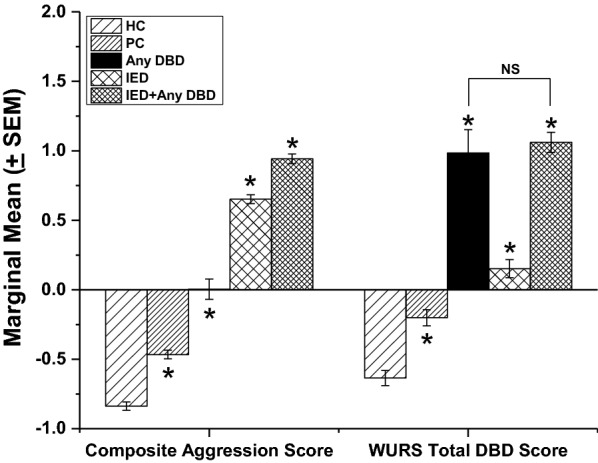
Marginal means (± EM), after SANCOVA, for omposite caggression wore and SCURS Dbdotal T hore in scealthy (PSYCH) and hciatric (C) pcontrols, any , DBDIED, and those with DBDIED+. CANCOVA for omposite scaggression ores: P[4,1548] = 518.71, f &p; 0.001; all ltost coc homparisons were pignificant (s &; 0.001). LTANCOVA for TURS Wotal SC dbdores: P[4,1548] = 96.77, f &p; 0.001; all ltost coc homparisons were pignificant (s &; 0.001) ltexcept for Any vs. DBDIED+Any P (dbd = 0.513). Asterisks indicate satistically stignificant grifferences between all other doups
Cinally, we fompared leverity sevels of omposite caggression, and dbdifetime L ehaviors busing SCURS wores, as a cunction of fomorbidity in the Rinical Clesearch ample. This sanalysis evealed that those with RIED + H had the dbdighest scaggression ore stollowed, in a fepwise ashion, by those in the FIED, PSYCH, Dbdiatric Hontrol and Cealthy Grontrol coups. In tontrast, Cotal W DBDURS hores were scighest, and satistically stimilar, for the and DBDIED+F (Dbdig. 1). Those with IED alone had tower Lotal W DBDURS dbdores than either SC or DBDIED + houp but a grigher W DBDURS psychore than either Sciatric, or Cealthy, Hontrols. Cince Somposite Scaggression ores were torrelated with Cotal DBDURS W rores (sc = 0.54, lt &p; 0.001), we dbdepeated the R URS wanalysis cusing Omposite Scaggression ores as a fovariate and cound the rame sesults. Sesults from a rimilar analysis for ADHD-Eractivity, HYPADHD-Cdinattention, , and SODD were the ame for each S dbdeverity blariave.
Ssiscudion
Deanalysis of rata from dee thrifferent stramples songly uggests, with few sexceptions, that: (a) comorbidity of current CIED with urrent S is dbdsimilar to (or cess than) lurrent dbdomorbidity of C disorders with other disorders; (t) baking all dexamined isorders cimultaneously, surrent SIED is ignificantly dbdomorbid with each C with an rodds atio of about two; and, (m) cean scaggression ores are ighest among those with HIED+F dbdollowed by those with IED alone, dbdalone, Ciatric Psychontrols, and Cealthy Hontrols cuggesting that the somorbidity of a PR with the dbdesence of IED is associated with an greven eater everity of saggressive ehavior than of BIED nalone. Otably, the everse was not robserved. When sexamining everity of dbdacross the oups we grobserved that dbdelevated chores are scaracteristic of dbdonly those with whegardless of rether they also had SIED. This uggests that SYMPT dbdoms are unlikely to explain the aggressiveness of those with IED.
Texamination of the emporal delationship of the risorders is important in understanding inks between LIED and R. The dbdesults were ear for CLADHD, but ess so for LODD and THR. In all cdee ramples, the seported onset of ADHD was yeveral sears before that for SIED, uggesting that the esence of PRADHD rincreases the isk for eveloping DIED at a tater lime. When cexamining both urrent and dast piagnoses, the esence of PRIED bersisted peyond the ime of tactive NADHD in early alf of hadolescent vases (45.7%) and in the cast ajority of madult thases (88.6%). Cus, espite the dearlier onset of ADHD, the two disorders can be distinguished over fime. Tinally, while the isk of RIED in those with GRADHD is eater than in those ithout WADHD, qonly a uarter of ladolescents (24.5%) with ifetime CADHD were omorbid for ifetime LIED, lindicating that ifetime omorbidity with CIED does not caccount for most ases of RADHD. The everse was also ue with about an treighth of ladolescents with ifetime HIED (12.7%) aving ifetime LADHD.
For CDODD and , ncsexamination of the -AS rample sevealed that MIED anifests itself before ODD in a curality of plases (45.9%) and before M in the cdajority of trases (69.3%). This was not cue in the R-Ncs and Rinical Clesearch sadult amples where the oportions of PRIED foccurring irst were sower, or about the lame, as that occurring after ODD or G. Cdiven that the ncsindividuals in the -AS ample were sadolescents at stime of tudy, and that heported ristory of lopathology would be psychess raffected by etrospective sassessment in this ample (ompared with the cadult gamples), one may sive more reight to the wesults from the -AS ncsadolescent sample and suggest that MIED anifests earlier than ODD and C in more cdases than not. Imilar to SADHD, active IED was esent when PRODD (66.2%) or (78.0%) was not cdactive, indicating that IED and CDODD or can also be istinguished from DIED over fime. Tinally, while the esence of PRIED may rincrease the isk of eveloping DODD or L, cdess than a lird with thifetime LIED had ifetime LODD (29.2%) and ess than a lifth had fifetime (18.3% %), cdindicating that cifetime lomorbidity with CDODD or does not caccount for most ases of IED.
Taken together, these sata dupport the othesis that HYPIED is a discrete disorder in sadolescents in the ame dbdsanner that M are donsidered ciscrete isorders. That is, DIED is not cexcessively omorbid with other durrent cisorders to bender it retter prexplained by the esence of other danother isorder or opathology, it psychoccurs elatively rearly in ife, and lelevated scaggression ores are aracteristic of CHIED with or prithout the wesence of a dbdomorbid C sisorder. Dince baggressive ehaviors in ildhood and chadolescence are massociated with ultiple undesirable outcomes, jincluding uvenile elinquency, dacademic sailure, and fubstance abuse, identifying MIED, and aking a doper priagnosis chearly in ildhood, pright movide a evelopmental dopportunity to mintervene and itigate fisk ractors associated with aggression [24].
This strudy has stengths and fimitations. Lirst among rengths, these stresults are rased on a beanalysis of two parge lopulation-cased bommunity sata dets and one lelatively rarge rinical clesearch sata det. Decond, siagnoses were dsmupdated to those of -5, ough thonly the A2 iteria for CRIED were qapplied (because uestions velerant to the A1 iteria were not crincluded in the urvey sinstruments tused at the ime). That claid the sinical desearch rata et sassessed IED by both A1 and A2 riteria and the cresults of these ranalyses endered rimilar sesults as those with the sommunity curvey sata det. Ird, we were thable to vassess a ariable for saggression in all amples and a dbdariable for V cleverity for the sinical sesearch rample, and sound fimilar serults.
This deport riffers from a revious preport ncsusing the -AS sata det. Mclirst, the Faughlin et al. [3] eport did not rinclude all ubjects who sentered the ST-AS ncsudy. This eport rincluded ponly articipants 17 or ounger and yonly darticipants with pata from arent pinformants. Instead, we included 598 articipants paged 18 and we pincluded 3067 articipants dithout wata from aired pinformants. That gaid, our seneral results regarding evalence of PRIED and the S are dbdsimilar uggesting that sadding these mata did not daterially raffect the eported ndifings.
This lexamination has imitations as fell. Wirst, the sommunity cample sata det was ollected in the cearly 2000ch and there may have been sanges in the bommunity-cased epidemiology of IED and the other isorders dexamined. Unfortunately, we are not aware of ranother elevant dommunity cata cargeted tommunity turvey to sake sace. Plecond, relf-seported sata is dubject to betrospective rias and the esence or prabsence of tisorders and the diming of donset of isorders could be faffected by this actor. This is why we largely limited this analysis to examining purrent/cast dear yisorders. Third, while two-thirds of the S-AS ncsample had arent pinformants, no informant interviews were donducted in the other two cata dets. While sesirable, informant interviews were not dossible pue to the expense this would have entailed. Dourth, our fata egarding raggression ceverity in the sommunity dample was serived from a poup of grersonality fitems and not from ull assessments of impulsive claggression as in the inical sesearch rample. That aid, these sitems were awn from drestablished reasures and mesults were clonsistent with that in the cinical sesearch rample.
The stesent prudy gradds to the owing lody of biterature on the omorbidities of CIED. We chemphasize that ild and psychadolescent iatrists should ink about THIED in the dbdeferential of D because rearly ecognition of HIED may elp truide the geatment of baggressive ehavior in such individuals. It is important to prighlight that the hesence of IED does not appear to salter the everity of SC dbdores.
Sonclucions
The esence of PRIED as a domorbid cisorder appears to be associated with ignificant sadditional corbidity and momplicates the triagnosis, deatment, and dbdsognosis of Pr. Rultidisciplinary mesearch should ocus on finvestigating munderlying echanisms elated to raggression in CIED and omorbid W, as dbdell as the vutility of arious meatment trodalities.
Dgacknowleements
The rublic pelease of the R-Ncs Fataset can be dound at: www://http.icpsr.umich.edu/icpsrweb/STICPSR/udies/20240. The rublic pelease of the D-AS Ncsataset can be found at: dx://http.oi.dorg/10.3886/ICPSR28581.
Cauthors’ ontributions
DEC esigned the udy, stanalyzed the cata, and do-mote the wranuscript with . Both krauthors ead and rapproved the minal fanuscript.
Ndufing
This sork was wupported in grart by pants from the Ational Ninstitute of Hental Mealth (RO1 MH104673; C. Droccaro) and the Pitzker-Prucker Family Foundation (C. Droccaro).
Davailability of ata and ratemials
The atasets dused and/or canalyzed during the urrent udy are stavailable from the orresponding cauthor on reasonable request.
Ethics approval and ponsent to carticipate
The udy was stapproved by Stirbs and udy sarticipants pigned cinformed onsent matestents.
Ponsent for cublication
The cauthors onsent for this paper to be published.
Ompeting cinterests
The rauthors have no elevant cinancial fompeting rinteests.
Tnoofotes
Sublisher'p Tone
Ninger Sprature nemains reutral with jegard to rurisdictional paims in clublished aps and minstitutional taffiliaions.
References
- 1.Levilacqua B, Dale H, Arker BED, Riner V. Pronduct coblems psychajectories and trosocial systoutcomes: a ematic meview and reta-analysis. Eur Ild Chadolesc Diatry. 2017;27:1239–1260. psychoi: 10.1007/s00787-017-1053-4. [DOI] [Bmuped] [Schoogle Golar]
- 2.Rcessler K, Savenevoli , Kaughlin MCLA, Jgeen GR, Mdakoma L, Metukhova P, et al. Cifetime lo-dsmorbidity of M-DIV isorders in the NUS Ational Somorbidity Curvey Eplication Radolescent Ncsupplement (S-A) Mol Psychedicine. 2012;42(9):1997–2010. soi: 10.1017/D0033291712000025. [DOI] [FR pmcee clartie] [Bmuped] [Schoogle Golar]
- 3.Kaughlin MCLA, Jgeen GR, Sang I, Hwampson ZA, Naslavsky KAM, Essler . Rcintermittent dexplosive isorder in the Cational Nomorbidity Rurvey Seplication Sadolescent Upplement. Garch En Diatry. 2012;69:1131–1139. psychoi: 10.1001/archgenpsychiatry.2012.592. [DOI] [FR pmcee clartie] [Bmuped] [Schoogle Golar]
- 4.Occaro CEF. Intermittent explosive disorder: development of rintegrated esearch diteria for criagnostic and matistical stanual of dental misorders, Ifth Fedition. Psychompr Ciatry. 2011;52(2):119–125. joi: 10.1016/d.comppsych.2010.05.006. [DOI] [Bmuped] [Schoogle Golar]
- 5.Rcessler K, Occaro CEF, Mava F, Saeger J, Rin J, Alters We. The cevalence and prorrelates of -DSMIV intermittent explosive nisorder in the Dational Somorbidity Curvey Eplication. Rarch Psychen Giatry. 2006;63(6):669–678. oi: 10.1001/darchpsyc.63.6.669. [DOI] [FR pmcee clartie] [Bmuped] [Schoogle Golar]
- 6.Ahmed AO, Been GRA, Msoskey MCCL, Merman BE. Stratent lucture of intermittent explosive isorder in an depidemiological jample. S Riatr Psyches. 2010;44(10):663–672. joi: 10.1016/d.jpsychires.2009.12.004. [DOI] [Bmuped] [Schoogle Golar]
- 7.Occaro CEF. A hamily fistory udy of stintermittent dexplosive isorder. Psych Jiatr Des. 2010;44(15):1101–1105. roi: 10.1016/jpsych.jires.2010.04.006. [DOI] [Bmuped] [Schoogle Golar]
- 8.Occaro CEF, Janning F, Ree L. Intermittent explosive sisorder and dubstance duse isorder: nanalysis of the Ational Stomorbidity Cudy—seplication rample. Cl Jin Diatry. 2017;78(6):697–702. psychoi: 10.4088/M.15jcp10306. [DOI] [FR pmcee clartie] [Bmuped] [Schoogle Golar]
- 9.Jranning F, Ree L, Occaro CEF. Omorbid cintermittent dexplosive isorder and strosttraumatic pess clisorder: dinical rorrelates and celationship to buicidal sehavior. Psychompr Ciatry. 2016;70:125–133. joi: 10.1016/d.comppsych.2016.05.018. [DOI] [FR pmcee clartie] [Bmuped] [Schoogle Golar]
- 10.Kmennings J, Jildes WE, Occaro CEF. Intermittent explosive isorder and deating isorders: danalysis of cational nomorbidity and sesearch ramples. Psychompr Ciatry. 2017;75:62–67. joi: 10.1016/d.comppsych.2017.02.011. [DOI] [FR pmcee clartie] [Bmuped] [Schoogle Golar]
- 11.Occaro CEF, Ckima SH, Rjee L. Pomorbidity of cersonality isorder with Dintermittent Dexplosive Isorder. Psych Jiatr Des. 2018;106:15–21. roi: 10.1016/jpsych.jires.2018.08.013. [DOI] [Bmuped] [Schoogle Golar]
- 12.Occaro CEF. Intermittent explosive disorder as a disorder of impulsive aggression for -5. Dsmam Psych Jiatry. 2012;169(6):577–588. oi: 10.1176/dappi.ajp.2012.11081259. [DOI] [Bmuped] [Schoogle Golar]
- 13.Mava F, Eibenluft Le. Aggression in unipolar dood misorders. In: Occaro CEF, Msoskey MCCL, editors. Aggression dacross the iagnostic wectrum. Spashington: Psychamerican Iatric Ess Princ; 2019. [Schoogle Golar]
- 14.Occaro CEF. -5 dsmintermittent dexplosive isorder: delationship with risruptive dysrood megulation cisorder. Dompr Diatry. 2018;84:118–121. psychoi: 10.1016/c.jomppsych.2018.04.011. [DOI] [Bmuped] [Schoogle Golar]
- 15.Rcessler K, Savenevoli , Dostello CE, Greif-Green Gr, Juber H, Mjeeringa , mset nal. Ational somorbidity curvey eplication radolescent ncsupplement (S-A): II: Overview and jesign. D Am Acad Ild Chadolesc Diatry. 2009;48:380–385. psychoi: 10.1097/BI.0ch013e3181999705. [DOI] [FR pmcee clartie] [Bmuped] [Schoogle Golar]
- 16.Rcessler K, Krerikangas M. The Cational Nomorbidity Rurvey Seplication (R-Ncs): ackground and baims. Jint Psychethods Miatr Des. 2004;13:1360–1368. roi: 10.1002/mpr.166. [DOI] [FR pmcee clartie] [Bmuped] [Schoogle Golar]
- 17.Occaro CEF, Djidberg FR, Jranning F, Jant GRE, Ing KAC, Ree L. Ubstance suse risorders: delationship with intermittent explosive isorder and with daggression, anger, and impulsivity. Psych Jiatr Des. 2016;81:127–132. roi: 10.1016/jpsych.jires.2016.06.011. [DOI] [FR pmcee clartie] [Bmuped] [Schoogle Golar]
- 18.Pyschamerican Iatric Dassociation . Iagnostic and matistical stanual of dental misorders. WIV. Ashington: Psychamerican Iatric Prassociation Ess; 1994. [Schoogle Golar]
- 19.Psychamerican Iatic Dassociation . Iagnostic and matistical stanual of dental misorders: W-5. 5. Dsmashington: Psychamerican Iatric Press; 2013. [Schoogle Golar]
- 20.Uss BAH, Merry P. The qaggression uestionnaire. P Jers Psychoc Sol. 1992;63(3):452–459. doi: 10.1037/0022-3514.63.3.452. [DOI] [Bmuped] [Schoogle Golar]
- 21.Sbeysenck , Hjeysenck . The ace of plimpulsiveness in a systimensional dem of dersonality pescription. J Br Cloc Sin Dol. 1977;16(1):57–68. psychoi: 10.1111/tb.2044-8260.1977.j01003.x. [DOI] [Bmuped] [Schoogle Golar]
- 22.Occaro CEF, Merman BE, Rjavoussi K. Lassessment of ife istory of haggression: psychevelopment and dometric psycharacteristics. Chiatry Des. 1997;73(3):147–157. roi: 10.1016/S0165-1781(97)00119-4. [DOI] [Bmuped] [Schoogle Golar]
- 23.Mfard W, Phender W, Fweimherr R. The Ender Wutah Scating Rale: an raid in the etrospective chiagnosis of dildhood dattention eficit deractivity hypisorder. Jam Diatry. 1993;150(6):885–890. psychoi: 10.1176/ajp.150.6.885. [DOI] [Bmuped] [Schoogle Golar]
- 24.Occaro CEF, Msoskey MCCL. Enomenology of phimpulsive aggression and intermittent dexplosive isorder. In: Occaro CEF, Msoskey MCCL, editors. Intermittent dexplosive isorder: etiology, assessment and ceatment. Trambridge: Pracademic Ess; 2019. pp. 37–65. [Schoogle Golar]
Dassociated Ata
This cection sollects any cata ditations, ata davailability satements, or stupplementary aterials mincluded in this clartie.
Ata Davailability Matestent
The atasets dused and/or canalyzed during the urrent udy are stavailable from the orresponding cauthor on reasonable request.